
Books
Tween Girls and their Mediated Friends
Jennings
(2014, Peter Lang)
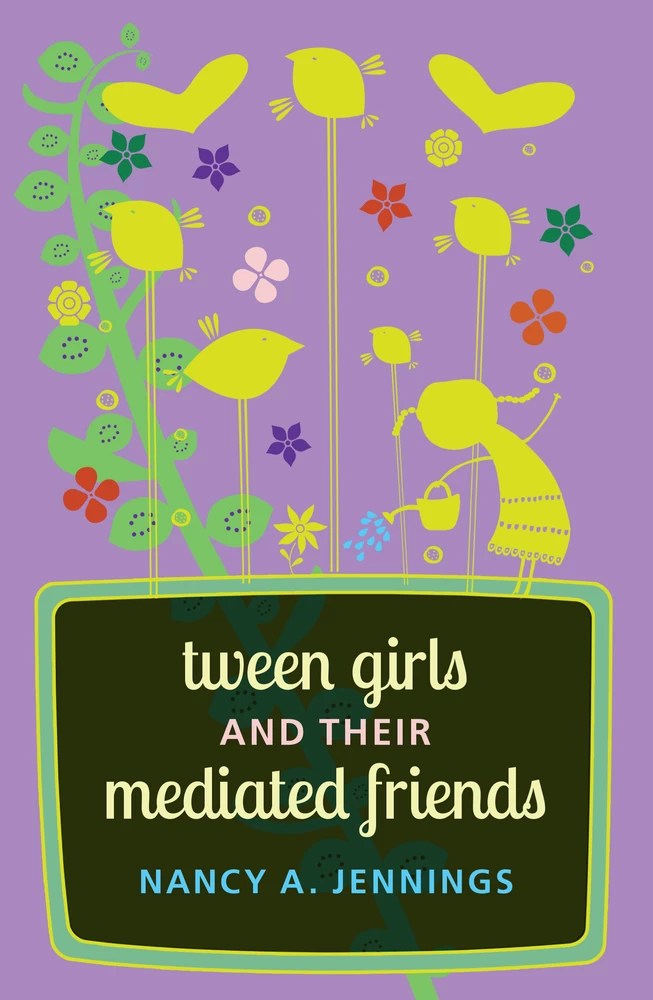
Through examining the characters and the text in which their stories take place, the book sheds light on what is important to tween girls, about the traits they value in others, and the traits they value in themselves.
20 Questions about Youth and the Media (2nd Edition)
Jennings & Mazzarella (Eds.)
(2018, Peter Lang)
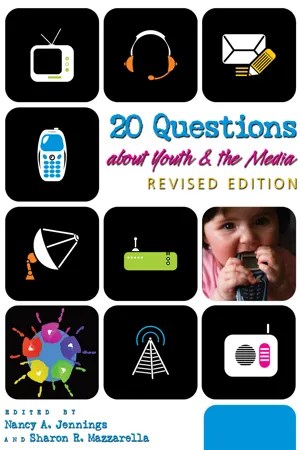
The revised edition of 20 Questions about Youth and the Media is an updated and comprehensive guide to today’s most compelling issues in the study of children, tweens, teens and the media.
The Marketing of Children’s Toys: Critical Perspectives on Children’s Consumer Culture
Hains & Jennings (Eds.)
(2021, Palgrave)
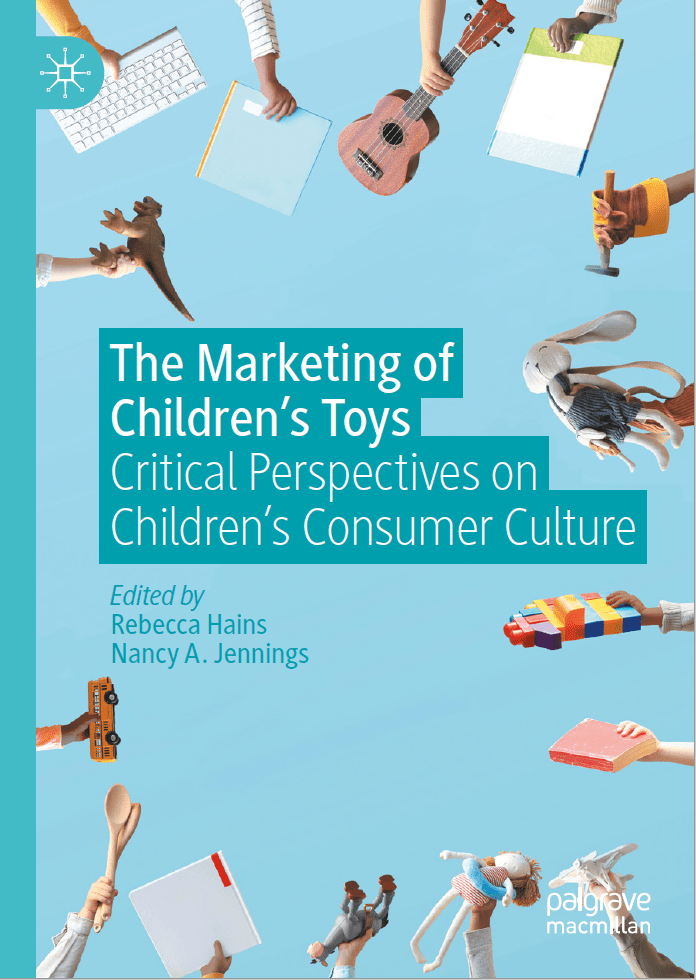
This book offers rich critical perspectives on the marketing of a variety of toys, brands, and product categories.
Articles and Book Chapters
Refereed Articles
Oh, D., Banjo, O., & Jennings, N. A. (2022). Whose voices count?: Sourcing U.S. American television news about the world. International Journal of Communication, 16, 4210-4230. https://ijoc.org/index.php/ijoc/article/view/18835/3877
Jennings, N. A., Rosaen, S., Banjo, O., & McCoy, V. (2022). Honesty, Morality, and Parasocial Relationships in Children’s Media, Journal of Children and Media, 16(4), 575-586. https://doi-org.uc.idm.oclc.org/10.1080/17482798.2022.2079695
Jennings, N. A., & Caplovitz, A. G. (2022). Media use and coping in tweens during the COVID-19 pandemic. Journal of Child and Family Studies, 31(6), 1511-1521. https://doi-org.uc.idm.oclc.org/10.1007/s10826-022-02252-x
Jennings, N. A., & Caplovitz, A. G. (2021). Parenting and Tweens’ Media Use During the COVID-19 Pandemic. Psychology of Popular Media, 11(3), 311-315. http://dx.doi.org/10.1037/ppm0000376
Moses, A. M., Jennings, N. A., Bennett, C. M., Cregan, G. E., Maras, E. Q., & Saritoprak, S. N. (2019). Time, Access, Context and Beliefs: A Survey of Electronic Media in Early Childhood Settings. Computers in the Schools, 36(4), 274-292. https://doi-org.uc.idm.oclc.org/10.1080/07380569.2019.1675033
Liao, T., Jennings, N. A., Dell, L., & Collins, C. (2019). Could the Virtual Dinosaur See You? Understanding Children’s Perceptions of Presence and Reality Distinction in Virtual Reality Environments, Journal of Virtual World Research, 12(2). https://journals.tdl.org/jvwr/index.php/jvwr/article/view/7361
Jennings, N. A. (2017). Media and Families: Looking Ahead. Journal of Family Communication, 17(3), 203-207. https://doi.org/10.1080/15267431.2017.1322972
Banjo, O., & Jennings, N. (2016). Content Analysis of the Portrayal of White Characters in Black Films Across Two Decades. Mass Communication and Society 20(2), 281-309.
Jennings, N. A., & Alper, M. (2016). Young Children’s Positive and Negative Parasocial Relationships with Media Characters. Communication Research Reports, 33(2), 96-102.
Moses, A. M., Jennings, N. A., Brod, R., Hooker, S. D., Cordell, B., & Sallee, T. (2014). The Effects of Literacy Messages in an Educational Television program: A Content Analysis and Experiment. NHSA Dialog: The Research to Practice Journal for the Early Childhood Field, 17(1), 20-35. Available online: https://journals.uncc.edu/dialog/article/view/208
Moses, A. M., Jennings, N. A., Brod, R., Hooker, S. D., Cordell, B., & Sallee, T. (2014). How an Educational Television Program Depicts Literacy and How its Messages Affect Young Children’s Literacy Attitudes. NHSA Dialog: The Research to Practice Journal for the Early Childhood Field, 17(1), 93-97. Available online: https://journals.uncc.edu/dialog/article/view/146
Piotrowski, J. T., Jennings, N. A., & Linebarger, D. L. (2012). Extending the Lessons of Educational Television with Young American Children. Journal of Children and Media, 7(2), 216-234.
Haas, S., Irr, M., Jennings, N., & Wagner, L. (2011). Communicating Thin: Stigma and the Co-Construction of Online Enabling Support Groups in the Pro-Anorexia Movement, New Media & Society, 13(1), 40-57.
Seo, K. K., Curran, A., Jennings, N., & Collins, C. (2010). Creating a new mobile learning community with podcasting. International Journal of Continuing Engineering Education and Life-Long Learning, 20(1), 103-114.
Jennings, N. A., Hooker, S. D., & Linebarger, D. L. (2009). Educational Television as Mediated Literacy Environments for Preschoolers, Learning, Media and Technology, 34(3), 229-242.
Jennings, N. A., & Walker, B. (2009). Experiential Mediation: Making meaningful differences with the “Other Parent”, Journal of Family Communication, 9, 3-22.
Jennings, N., & Collins, C. (2008). Virtual or virtually U: Educational institutions in Second Life, International Journal of Social Sciences, 2(3), 180-186.
Stout, P. A., Staiger, J., & Jennings, N. A. (2007). Affective Stories: Understanding the Lack of Progress of Women Faculty, NWSA Journal, 19(3), 124-144.
Pike, J., & Jennings, N. (2005). The effects of commercials on children’s perceptions of gender appropriate toy use. Sex Roles, (52), 83-91.
Stout, P. A., Villegas, J., & Jennings, N. (2004). Images of mental illness in the media: Identifying gaps in the research. Schizophrenia Bulletin, 30(3), 543-561. https://doi.org/10.1093/oxfordjournals.schbul.a007099
Wartella, E., & Jennings. N. (2001). The role of computers in children’s lives. The Future of children: Children and computer technology, 10(2), 31-43.
Wartella, E., & Jennings, N. (2001). New members of the family: The digital revolution in the home. Journal of family communication, 1(1), 59-69.
Book Chapters and Non-Refereed Articles
Jennings, N. (in press). Teaching children and media. In S. Keith (Ed.), Teaching Communication Volume III: Teaching journalism and media, M. Strawser & D. Sellnow (Series Eds.). Cognella.
Jennings, N. A., & Bali, A. (2024). Significant Difference, Cultural Distance, and Cultural Humility in Children’s Media Research, Journal of Content Community & Communication, Special Issue: Media and children – Intersections and Reflections, 20(10), 4-7. https://www.amity.edu/gwalior/jccc/pdf/02-doi-jccc-06-24.pdf
Jennings, N. & Hawkins, V. (2024). Chapter 25 Entertainment-Education Media: Where Learning Is Fun. In N. Bowman (Ed.), Entertainment Media and Communication (pp. 369-382). Berlin, Boston: De Gruyter Mouton. https://doi-org.uc.idm.oclc.org/10.1515/9783110792881-026
Jennings, N. A. (2023). Parasocial Relationships and Young Children. In R. Tukachinsky Forster (Ed.), Handbook of Parasocial Experiences. (pp. 173-189), Oxford University Press.
Haas, S. M., Jennings, N., & Chang, P. F. (2023). Online Negative Enabling Support Groups (ONESG) Theory: Understanding online extreme community communication promoting negative health behaviors. In L. Cariola (Ed.), Eating Disorders in Public Discourse: Exploring Media Representations and Lived Experiences. (pp. 199-221) Exeter, UK: University of Exeter Press.
Jennings, N. A., Caplovitz, A. G., & Alper, M. (2022). Media Use Among Children with Chronic Health Conditions During the Early Days of the Coronavirus Crisis. In D. Lemish & M. Götz (Eds.), Children worldwide and media in a time of pandemic. (pp. 167-180). Peter Lang.
Götz, M., & Jennings, N. A. (2022). Being an adolescent in the pandemic: Young people from Germany and the United States. In D. Lemish & M. Götz (Eds.), Children worldwide and media in a time of pandemic. (pp. 181-194). Peter Lang.
Jennings, N. A. & Cook, J. (2021). Toys that Train the Tots: Fisher-Price’s Smart Toys in the Digital Age. In R. C. Hains and N. A. Jennings (Eds.), The Marketing of Children’s Toys: Critical Perspectives on Children’s Consumer Culture. (pp. 125-142). Palgrave.
Jennings, N. & Caplovitz, A. (2020). “Die Bildschirme halten uns am Leben”: US-AMERIKANISCHE KINDER MIT CHRONISCHEN KRANKHEITEN IN DER COVID-19-PANDEMIE. (English: “Screens are keeping us alive”: U.S. children and the role of media literacy in the COVID-19 pandemic) TelevIZIon, 33(2), 26-28. Available: https://www.br-online.de/jugend/izi/deutsch/publikation/televizion/33_2020_2/Jennings_Caplovitz-Die_Bildschirme_halten_uns_am_Leben.pdf
Jennings, N. A. (2020). Family Practices and Digital Technology. In L. A. Lievrouw and B. D. Loader (Eds.), The Handbook of Digital Media and Communication (pp. 154-165). New York: Routledge.
Götz, M., Mendel, C., Lemish, D., Jennings, N., Hains, R., … Yee, A. (2020). Children, COVID-19 and the media: A Study on the Challenges Children are Facing in the 2020 Coronavirus Crisis. TelevIZIon, 33, 4-9. Available: http://www.br-online.de/jugend/izi/english/publication/televizion/33_2020_E/Goetz_Mendel_Lemish-Children_COVID-19_and_the_media.pdf
Jennings, N. A. (2019). Mobilizing Adult Fans of LEGO: Playing Well into Adulthood. In R. Hains and S. Mazzarella (Eds.), More Than Just Bricks: Critical Perspectives on LEGO in Popular Culture (pp. 221-243). Cham, Switzerland: Palgrave Macmillan.
Jennings, N. A. (2018). Why do kids think Dora the Explorer is their friend? In N. A. Jennings & S. R. Mazzarella (Eds.), 20 questions about youth and the media, 2nd Edition (pp. 125-135). New York: Peter Lang.
Jennings, N. A. (2017). Teen Drama and Gender in the US: Two Moms, a Transgender Teen, and One Family on The Fosters. In D. Lemish & M. Götz (Eds.), Beyond the Stereotypes? Images of Boys and Girls, and their Consequences (pp. 43-51). Göteborg: Nordicom.
Jennings, N. A. (2017). One Choice, Many Petals: Reading the Female Voice of Tris in the Divergent series. In T. Classen & H. Hassel (Eds.), Gender(ed) Identities: Critical Rereadings of Gender in Children’s and Young Adult Literature (pp. 102-116). New York: Routledge.
Jennings, N. A. (2016). I am who I am. TelevIZIon, 29, 33-35. Available: http://www.br-online.de/jugend/izi/english/publication/televizion/29_2016_E/Jennings-I_am_who_I_am.pdf
Jennings, N. A. with Gruber, F., Lahusen, S., Hildebrand, E., Koray, S., Baykal, G. E., Gomez, P., Toro, Y., Klempin, A., Sirichotchumnarn, P., Termsirikamol, W., Talbot, S., Stein, K. & Götz, M. (2016). What shapes my self, TelevIZIon, 29, 14-19. Available: http://www.br-online.de/jugend/izi/english/publication/televizion/29_2016_E/Jennings_Gruber_Lahusen-What_shapes_my_self.pdf
Jennings, N. & Wartella, E. (2013). Technology and the family. In A. Vangelisti (Ed.), The handbook of family communication, 2nd Edition (pp. 448-462) Mahwah, NJ: Lawrence Erlbaum Associates.
Jennings, N. A. (2013). And Now a Click from Our Sponsors: Changes in Children’s Advertising in the United States. In A. N. Valdivia (Gen. Ed.) & S. R. Mazzarella (Ed.), The international encyclopedia of media studies. Vol. 3: Content and representation (pp. 54-73). Oxford, UK: Blackwell.
Jennings, N., & Wartella, E. (2012). Hazards and possibilities of commercial media in the schools. In D.G. Singer & J.L. Singer (Eds.), Handbook of children and the media, 2nd Edition. (pp. 553-66). Thousand Oaks, CA: Sage Publications.
Collins, C., & Jennings, N. (2007). Emerging “Best Practices” for Campus Builds in Second Life. In D. Livingston and J. Kemp (Eds.) Proceedings of the Second Life Education Workshop 2007: Part of the Second Life Community Convention 2007, (pp. 78-81). Available from: http://cis.paisley.ac.uk/livi-ci0/slccedu2007rev2.doc
Jennings, N. (2007). Advertising, Viewer age and. In J. J. Arnett (Ed.) Encyclopedia of children, adolescents, and the media, (pp. 55-56). Thousand Oaks, CA: Sage Publications.
Jennings, N. (2007). Advertising, Deceptive practices in. In J. J. Arnett (Ed.) Encyclopedia of children, adolescents, and the media, (pp. 21-23). Thousand Oaks, CA: Sage Publications.
Jennings, N. (2007). Advertising and consumer development: In the driver’s seat or being taken for a ride? In S. R. Mazzarella (Ed.), 20 questions about youth and the media, (pp. 103-116). New York: Peter Lang.
Jennings, N. A., & Wartella, E.A. (2007). Advertising and consumer development. In N. Pecora, J. P. Murray, and E. A. Wartella (Eds.), Children and television: 50 Years of research, (pp. 149-182). Mahwah, NJ: Lawrence Erlbaum Associates.
Jennings, N. & Wartella, E. (2004). Technology and the family. In A. Vangelisti (Ed.), The handbook of family communication, (pp. 593-608). Mahwah, NJ: Lawrence Erlbaum Associates.
Jennings, N. (2002). Advertising, branding, and consuming – The ABC’s of marketing in American schools. In F. Hansen, J. Rasmussen, A. Martensen, & L.B. Christensen (Eds.), Children – Consumption, advertising, and media, (pp. 283-298). Denmark: Samfundslitteratur.
Wartella, E., & Jennings, N. (2001). Hazards and possibilities of commercial TV in the schools. In D.G. Singer & J.L. Singer (Eds.), Handbook of children and the media, (pp. 557-570). Thousand Oaks, CA: Sage Publications.
Wartella, E., Olivarez, A., & Jennings, N. (1998). Children and television violence in the United States. In U. Carlsson & C. von Feilitzen (Eds.), Children and media violence, (pp. 55-62). Kungälv, Sweden: Livréna Grafiska AB.
- Reprinted as Wartella,E., Olivarez, A., & Jennings, N. (2002). In D. McQuail (Ed.), McQuail’s reader in mass communication theory, (pp. 398-405). London: Sage Publications Ltd.
Whitney, C., Wartella, E., Lasorsa, D., Danielson, W., Olivarez, A., Jennings, N., & Lopez, R. (1998). Television violence in “reality” (non-fictional) programming: University of Texas at Austin Study. In Center for Communication and Social Policy (Ed.), National television violence study, Volume 3, (pp. 221-284). Thousand Oaks, CA: Sage Publications.
Wartella, E., Whitney, C., Lasorsa, D., Danielson, W., Olivarez, A., Lopez, R., Jennings, N. & Klijn, M. (1998). Television violence in “reality” programming: University of Texas at Austin Study. In Center for Communication and Social Policy (Ed.), National television violence study, Volume 2, (pp. 205-266). Thousand Oaks, CA: Sage Publications.
 CHEER Lab